• Een wondere wereld

    In 2015, for the first time, I was afraid. Afraid for my precious Europe...
  • Bragging rights

    Boston broke the all-time seasonal snowfall record today! Fascinated by the immense amounts of snow, and mildly frustrated that all measurements were announced in inches rather than in centimeter, I decided to download the snowfall data and make my own figures.
  • Let it snow, let it snow, let it snow

    The first two snowy weeks of a semester in Boston!

maandag 16 maart 2015

Today came the announcement that it finally happened: Boston broke the all-time seasonal snowfall record today! This winter, 275.8 cm (108.6 inches) of snow has fallen at the Boston Logan station. The previous record was set 19 years ago, when 273.3 cm fell in the winter of 1995-1996. Those who experienced that winter now officially have their bragging rights revoked!

When I got to Boston at the end of January it was quickly becoming clear that February was quite exceptional, and record after record fell. We had the snowiest 7 days on record, the snowiest 30 days, the snowiest February, ... However, as close as we were to the all-time record at the beginning of March, there was no guarantee for breaking it and there were 11 snow-free days until the record was finally set today. With a taste of spring, the record-fever disappeared, until somewhat unexpectedly the last few centimeters of snow fell today!

Fascinated by the immense amounts of snow, and mildly frustrated that all measurements were announced in inches rather than in centimeter, I decided to download the snowfall data and make my own figures. 


The cumulative snowfall shows all previous snowfalls per winter, and highlights the previous top 3, as well as this year's record. For convenience I have reported values both in centimeter and inches. The data was gathered as Boston Logan weather station, which has data that goes back to 1936, although I have not included the first two years because it appears to contain some erroneous measurements. Since 1938, the data is uninterrupted and winter and summer, the snowfall is measured daily. The data can be freely downloaded from the National Oceanic and Atmospheric Administration (NOAA) I have divided it into seasons which are shown as grey lines. Their average is shown in black, which is calculated by counting days since the start of the winter to deal with leap years. (The data analysis which produced the figures was done in Python. The figures may be freely reused as long as their source is credited.)

What is obvious from the cumulative snowfall figure is that this winter's snow was heavily concentrated around February (when do you think I arrived to Boston?). The following figure shows snowfall during the past 30 days at any date:


This means that any point in this figure represents how much snow has fallen during the 30 days prior to it (including the day itself). On February 22, 239.7 cm (94.4 inch) of snow had fallen in the previous 30 days! It's clear that nothing like that has happened in the 77 previous years. A similar (though slightly less impressive) figure can be made for a 7-day window.

Finally, I have attempted to describe the seasonal snowfall by a simple Gaussian distribution. The best fitted distribution has a mean snowfall of 111.1 cm, with a standard deviation of 53.1 cm:

However, when this distribution is illustrated in a histogram, it is clear that a Gaussian distribution does not provide a great fit. For one, true snowfall obviously never goes below zero (in fact, the least observed is 23.7 cm). Snowfall in the range of 40-150 cm is fairly common, with a few exceptions exceeding that range, such as the winter of 1947-1948, 1993-1994, 1995-1996 and now 2014-2015.

Finally, is there much more snow to come? That's hard to say. Looking at the cumulative snowfall (top figure), the black curve (indicating the mean) is clearly starting to flatten out, indicating most snow has most likely fallen by now. Nevertheless, snowfall in March (and April) has a significant scatter, with some seasons getting no snow at all and others getting 1-2 significant storms. 

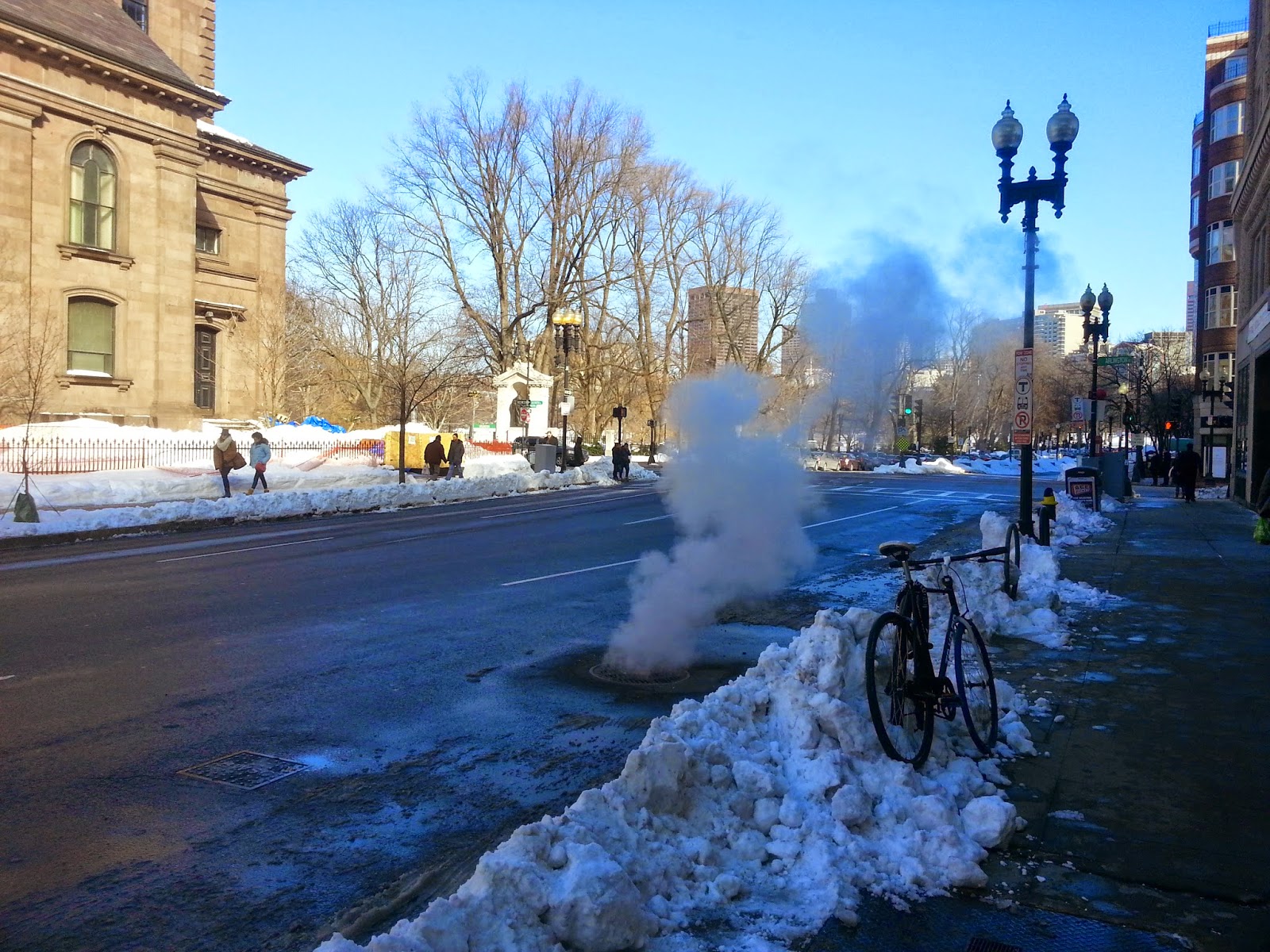
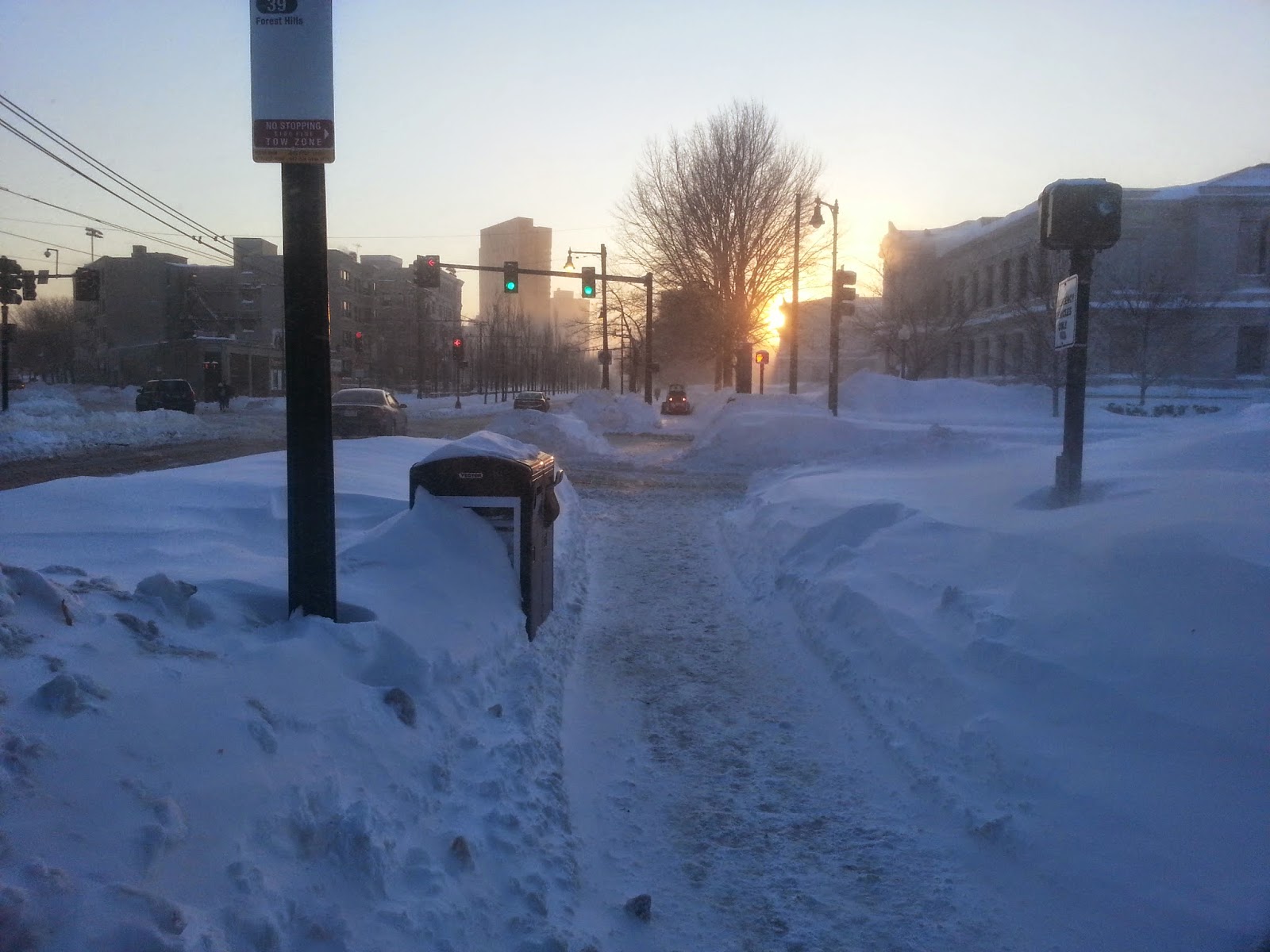
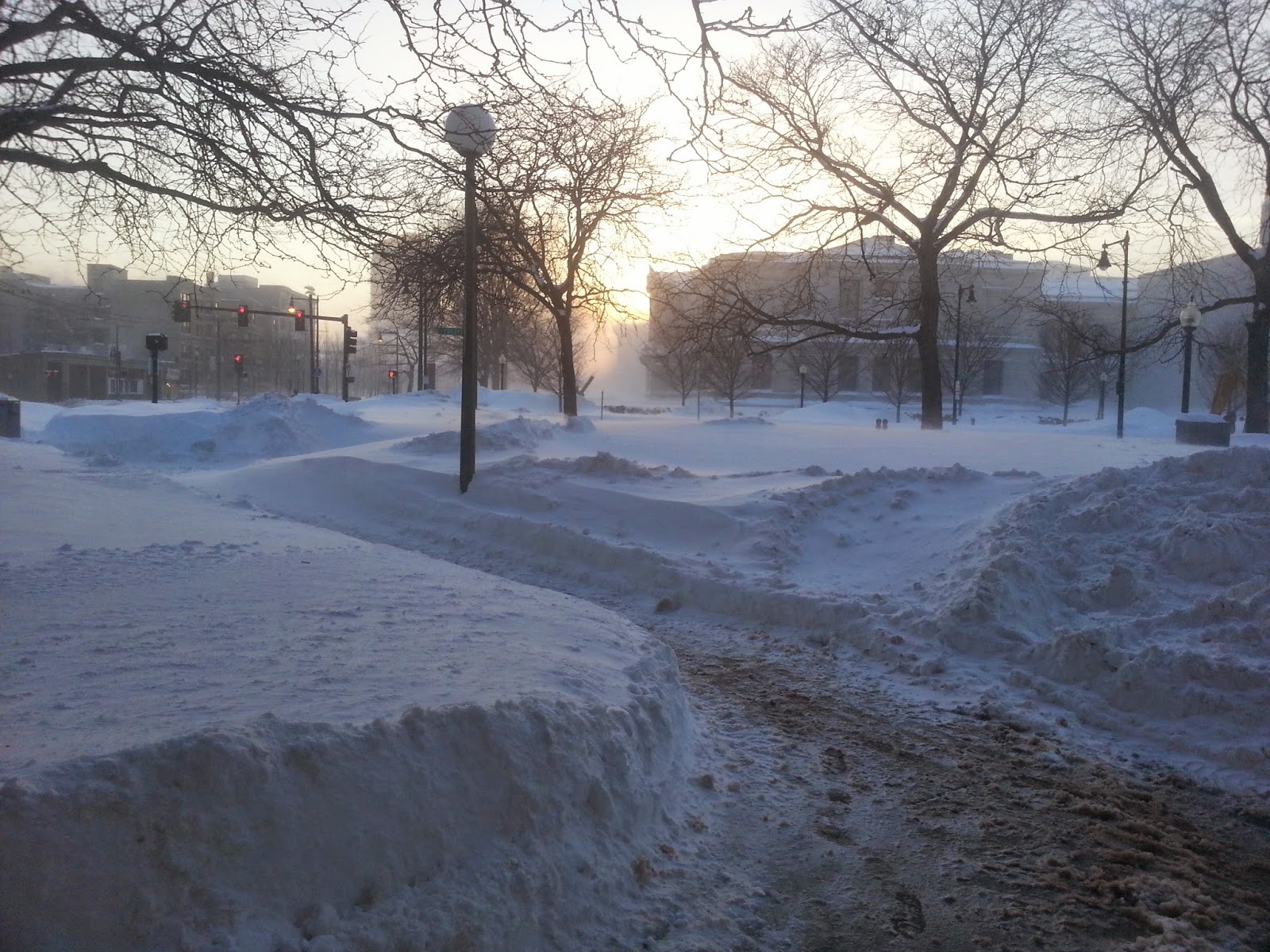
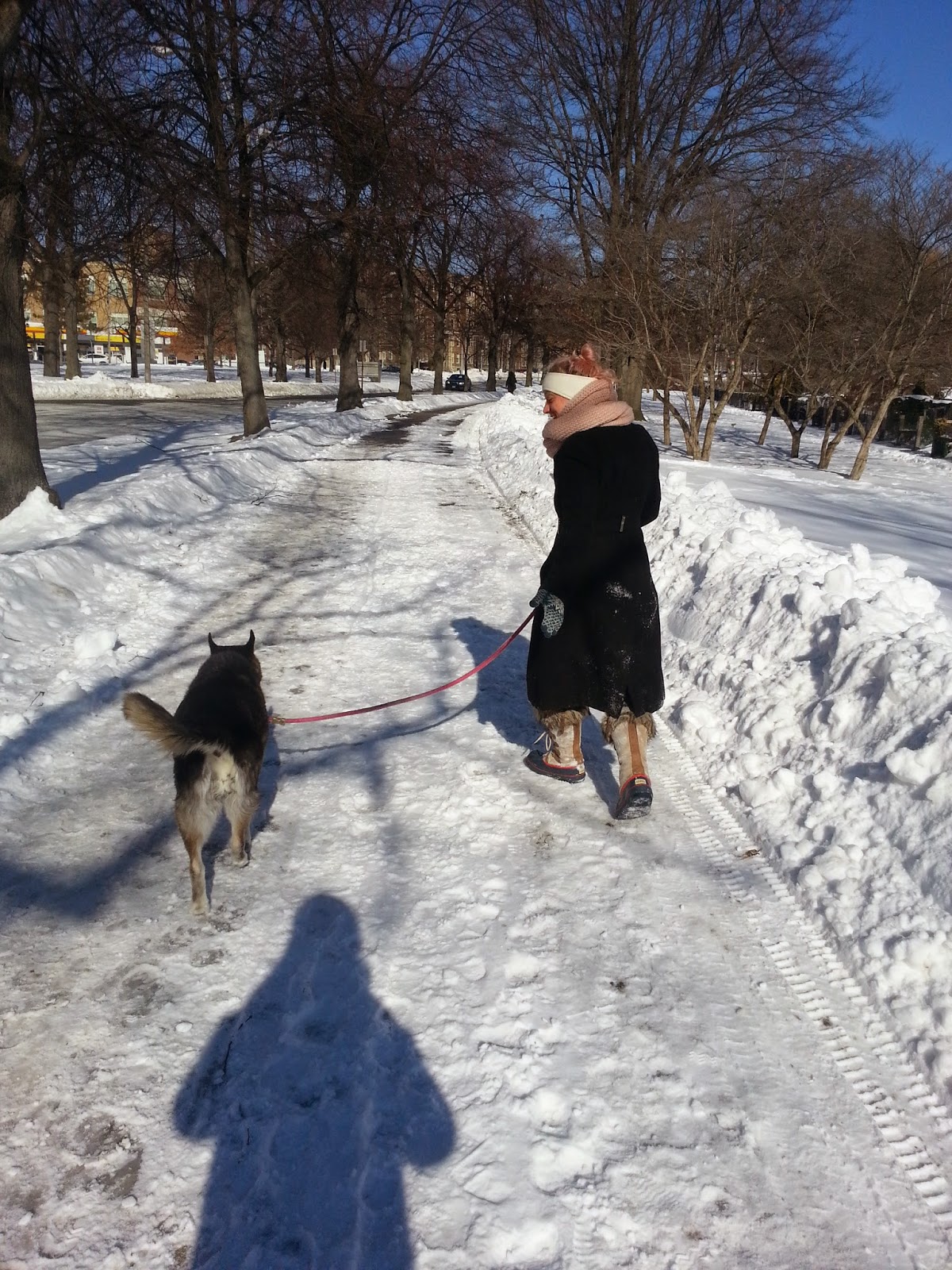
Below are some snowy pictures. To be fair, most were not taken in the last few days, and the city looks quite a bit less surrealistic these days. Some pictures were taken at an area which was used by MIT to collect the snow removed from its campus, a place which became known as The Alps of MIT.




zondag 15 februari 2015


In between days with flights canceled due to snow storms, I safely got to Boston two weeks ago for the start of a semester of PhD research at MIT. But before I dig into the snow situation, let me say a word about my flights. Last year I wrote a post about my frustrations with Lufthansa, but this time my experience was much better. With a delayed flight into Munich, I would have missed my connection to the States if it wasn't for a personal service bus picking me up directly from the plane, driving me over the tarmac to the right terminal and channeling me through security. Ten minutes later I had my seat belt fastened on my connecting flight with a few minutes spare.


Upon arrival the cold hit me, even if I spent only a few minutes waiting for a taxi. The temperature was around -10 degrees (Celsius, of course) but it was the wind that really caused the damage. I was very thankful for the fresh soup my new flatmate and her beautiful dog had prepared me upon arrival. Within days I would become familiar with the concept of wind chill and the associated warnings about frostbite omnipresent in the weather forecasts. But cold we can deal with, armed with a thick scarf and the blue cap my friend Sanne made me (thanks!), and most importantly with a few years of experience with Danish winter.


But then there is the snow. Here one may argue that Denmark also gets snow in winter, but it would be like pointing out there's no need to worry about a sunburn in the Canary Islands because the same sun can sometimes be observed from Denmark. Technically correct but also largely irrelevant. The amount of snowfall is of another order of magnitude. The dynamics are altered. Usually during or shortly after the snow, the roads get plowed and a salty mixture melts the remains into a layer of dirty slush. To be fair, that happens here too. But it is not as simple as that. One of the more intriguing complications that I had never previously considered: what to do with all the snow?


When a storm drops half a meter of snow, the streets still get cleared and so do the sidewalks, but that leaves immense piles of snow safely separating cars from pedestrians. The piles block part of the road and can greatly limit visibility at crossroads. A day or two after heavy snowfall the sidewalks are usually in decent shape (although a bit of acrobacy can be helpful to avoid getting stuck), thanks to relentless efforts from city employees and civilians. Boston has a law which requires its citizens to shovel the walkways in front of their houses within hours after the end of any plowable event. Empty lots are used as snow farms to deposit excess snow but even they have their limits. Dumping the snow into the Charles River is prohibited for environmental reasons, although there has been some debate about temporarily lifting the ban. During the last few days the city has been aggressively melting snow as well as literally driving truckloads out of the city, to make room for more to come.


Even for a city that is used to winter storms I am told that this year is exceptional and the statistics back that up. Some all time records have already been broken, including those of most snow in seven as well as thirty day time spans and that of most snow in February (already!). The winter has entered the “Top 10” of overall snowfall records and there are still a few weeks of prime snowing season left to attack the winter of 1995-1996's all-time record. The Boston metro (“The T”) has had trouble operating and even closed entirely last Tuesday – its head has meanwhile resigned. When storms are the worst schools close and kids get a snow day. Such days are anticipated every winter and compensated elsewhere, but with the amount of snow days this season (four in the last two weeks only) the summer holiday may get shortened.


Although I am looking forward to explore the city under more Spring-like conditions, the weather is excellent for hot chocolate and research productivity. I have been welcomed by very nice people and I watched my first ever Super Bowl (and even liked American Football!). I ordered snow boots and joked that their arrival would keep the snow away. Since I got them on Tuesday that has worked surprisingly well, but while I am writing this the National Weather Service has issued a blizzard warning for tonight and tomorrow. They predict the winter storm will bring a foot of snow or more, by which they mean about 30 cm should be expected.


As I started to complain about even more snow and even less space to put it, the news struck about two terror attacks in the Danish capital leaving two dead and several wounded to place it all into perspective. So let it snow. But while we are at it... let's break that 1995 record so there is something to write home about!


maandag 28 april 2014


A few weeks ago, my friend Tine visited me in Aarhus, and during the past Easter weekend I had the pleasure of welcoming my parents. Since they've seen Aarhus before and I haven't been exploring the rest of Denmark much, this provided us with the perfect occasion for a three-day trip around Fyn, the large Danish island. 


After having provided them with a fine dinner on Thursday (and myself being provided with some goodies from Belgium - yes, some Belgian beer and chocolate), on Friday we took off to Odense, Fyn's main city. The place is mostly known as the birthplace of Hans Christian Andersen, the famous Danish poet. We therefore had to visit the H.C Andersen museum as well as take the Andersen-route through the city. 

However, it turned out there was more to Odense than the 19th century writer of fairytales, and the photo museum was certainly worth the visit. The city itself was nice and quiet, with some great parks, and a nice Italian place to finish the day.


zaterdag 4 januari 2014

More than a year and a half ago, I first came across this blogpost ("What Happens When You Live Abroad") by Chelsea Fagan. She writes about moving abroad and about a feeling of belonging in more than one place. Consequentially, there is always a part of you that is far away from home. 

More than two years after I first left Belgium, these words still articulate a feeling that perhaps will never entirely disappear (and that does not have to be a bad thing). I know the message resonates with many people who live abroad, and it is phrased so much nicer than I could ever put it to words, so I am re-posting it here.


woensdag 1 januari 2014


In 2013 there was a big train crash in Spain, Syrian children died of nerve gas and the Philippines got hit by a major typhoon, while Edward Snowden dramatically demonstrated the relativity of privacy. The Boston marathon got startled by a bombing, a Nairobi shopping mall got invaded by terrorists. Belgium changed Kings from Albert to Filip, the Vatican traded Benedictus for Franciscus. 

In Thirteen, Europe didn't fall apart and the recovery from crisis times has really begun. May Europe really overcome its internal struggles in 2014 and may European solidarity regain its true meaning. May Ryanair fly you to pretty European cities! May new generations of European students become the continent's ambassadors, educated in different countries through Erasmus exchanges. From Belgium to Denmark, Germany through Greece, in Romania or Spain, places are beautiful and people are pretty. May you discover the continent, great in diversity! A Europe which can unify and aid where necessary and preserve all the unique cultures, is a wonderful project which deserves your optimism and encouragement! For the people from Belgium, I wish for us to be a bit more conscious and proud of the great things our little but beautiful country possesses, and of course that we may be victorious at the World Cup in Brasil!

A year ago, I wrote here about my New Year's resolutions for the past year. I announced I would start to play the piano again, as well as to learn the Danish language and speak it fluently. I did buy myself an electric piano and have played it a bit, albeit not nearly regularly enough to really improve on my (very basic) skill level. I have spent most of the year in Danish class at LaerDansk, where I unfortunately missed the exam of the final module 5, as I was in the US in November. However, people will now have a hard time gossiping about me in my presence, and I can watch Borgen without subtitles. 

So perhaps there is still a little bit of room for improvement for both - does anyone know a nice piano teacher in Aarhus? And for my Danish colleagues, så snakker vi kun på Dansk! Jeg kan godt forstå det, du må bare hjælpe mig lidt! - but largely, mission accomplished! The biggest personal achievements during the year Thirteen have really been job related. I published a paper in Summer and had another one accepted for publication. I talked about this last one - of which I am especially proud and in which we discovered a new interesting exoplanet! - at MIT and at Harvard and presented it on a poster at the NASA Kepler conference. I've been to the US three times in the past year, I operated a telescope for the very first time in La Palma, I had a great summer school at the beautiful Onsala in Sweden. I've been teaching students about exoplanets, during a course which only two years ago was my own very first introduction to the research field. 

'13 for me has also meant really settling down in Aarhus. Many nice new friends have made me feel at home. While an international environment inevitably means no one stays forever - sadly, Sandra, one of the nicest people who was there from day one of my Erasmus experience, went back to Spain a few weeks ago - I have high hopes for there to be some lasting friendships nevertheless. Finding a lovely apartment in the middle of town and an even greater roommate Catalina has also played a big role in calling Aarhus home!

As publicly announcing resolutions appears to be beneficial for their chances of success, here it is again. In 2014 I intend to explain more astronomy to everyone. Many scientists do really great research, largely funded by tax payer's money. Unfortunately is often complex and difficult to bring to a broad audience. I will make my own little contribution by attempting to explain some of the universe's most interesting mysteries to anyone that may be interested. I will be happy to talk about extra-solar planets which may be quite like or unlike our Earth and some of which may have life. No matter your scientific background, as long as you are interested or intrigued. Secondly, I want to find the time in 2014 to travel for longer than two weeks and discover a country I haven't seen before.

What I finally wish for everyone for 2014 is spelled out in the Holstee Manifesto at the bottom of this page. This is your life. Do what you love, and do it often. Life is short. Live your dream. Wear your passion. Hello 2014! Happy New Year!


Vincent

vrijdag 20 december 2013

November 2013 was the third time I met with the United States this year, and this time we saw each other for more than a few days. The first destination: San Francisco, or more precisely, Mountain View. The headquarters of NASA Ames is located there, and they were hosting the second Kepler science conference. Despite a worthy try by the American politicians to interfere with the conference by shutting down the government only weeks before, the science meeting took place as scheduled and we spent a week discussing results using the Kepler satelite's data, and their implications on exoplanet research.

Being together with a few hundred colleagues from all over the world to discuss science always has something inspirational to it. The conference's public lecture was given by prof. Frank Drake, known to astronomers and non-astronomers alike as the person behind the Drake equation. This equation, which he failed to mention at any point during his talk, predicts the chance of having life on another planet by multiplying factors such as the amount of stars, the amount of planets and the amount of planets which can support life. I share a sense of optimism with most exoplanet researchers that there is likely life somewhere out there, and that we might be able to detect it in the not too distant future. Or to paraphrase Frank Drake, perhaps we will soon connect to the intergalactic internet.

As with any conference, you need something remarkable to happen to make it worth remembering. This time the price went to my advisor, whose rental car turned out to be a white Mustang (with remarkably little space in the back seats).


Mogelijk gemaakt door Blogger.